01 · ENGAGEMENTS
-
dentsu
AI transformation and communications across 46 EMEA markets and 17,000 employees, turning EU AI Act and AI Pact obligations into operational practice.
-
25+ organisations
Interim leadership and organisational design across AI, digital health, and climate tech.
-
Ethical Angel
Turnaround and operating-model reset, rebuilding a £1.4M qualified pipeline.
-
Safe Citizens
Formed and led a 12-partner consortium across seven countries, securing Horizon Europe support.
-
DeCIF
National advocacy campaign endorsed by the All-Party Parliamentary Group on Dementia.
02 · WAYS TO WORK TOGETHER
Four ways in, from a half day to a full engagement. Each one is scoped before it starts, and each one ends with something written down that people can act on.
EU AI Act exposure check
For a leadership team that touches the EU and does not yet know where the Act applies.
Half a day, in the room, walking every AI-touching activity through the five high-risk triggers.
You leave with a one-page exposure map: each activity, its tier, the roles affected, and the three actions that matter first. £950 fixed, VAT added where applicable.
EU AI Act masterclass
For leadership teams, client groups, and events. Two versions: agencies and creative businesses, and mid-tier regulated firms.
Sixty to 90 minutes on what is in force, what is coming, and what changes for the people in the room, in the language of their work.
You leave with a one-page summary and one thing to check that week. £1,200 as a private session, VAT added where applicable.
Leadership working session
For a senior team that has decided to take AI seriously and has not agreed what that means.
A 20-minute conversation with each leader first, so the half day is anchored on what each of them is already measured on. Then the session.
You leave with a written record of what was decided and a 90-day plan. Fixed fee, scoped on a call.
Policy to practice
For the transformation or compliance lead who owns an AI policy but not its adoption.
Four to eight weeks turning the policy into guardrails (approved, ask first, prohibited), playbooks for the roles that matter most, the workflows that change, and the communications that carry it.
You leave with the policy working in the workflow, and a way to tell whether behaviour moved. Scoped on a call as a set number of days and a defined deliverable.
Not sure where you sit? Take the five-minute check.
I also work inside programme teams on interim and contract terms, leading a workstream or joining one, usually on multi-market adoption, governance into practice, and communications.
03 · WHAT I DO
AI adoption and AI change inside large organisations is the work; governance, communications, and regulatory readiness are how it gets done.
Transformation and change
Multi-market rollout, operating-model design, and the behaviour change that decides whether any of it holds.
Communications and narrative
Message architecture, executive narrative, and multi-channel engagement for audiences in the tens of thousands.
AI governance and regulatory readiness
EU AI Act and AI Pact obligations turned into policy, training, and practice that people actually follow.
From strategy to shipped
I stay until it works in the workflow, not just on the slide.
04 · QUESTIONS PEOPLE ASK BEFORE THEY BUY
We are a UK business. Does the EU AI Act apply to us?
If you sell to EU clients, sell to UK clients who operate in the EU, or put AI into what you deliver to either, some of your work is in scope. The UK has chosen not to adopt an equivalent law; the FCA is using Consumer Duty as its lens instead. That does not switch off the EU rules for EU-facing work.
The deadlines moved. Why would we do anything now?
Most of the high-risk obligations are now due at the end of 2027. Three things did not move: the transparency rules for AI-generated content are already in force, your clients' procurement questionnaires already ask about AI in your work, and the obligations for AI your people use without telling you fall on the business, not the individual. The work now is small and cheap. The same work in late 2027 will be neither.
Is this legal advice?
No. It is operational work: what changes for named roles, what the guardrails are, what people are told and how. It sits alongside whatever your lawyers have told you.
You will tell us we have a problem and then charge us to fix it.
The exposure check is designed to start something, not to end it. It gives you the three actions that matter first and the roles they fall on. Some teams take those on themselves. Most find the useful next step is a follow-on engagement, agreed before it starts as a set number of days and a defined deliverable, so you know what you are buying and what you will have at the end. Nothing is sold in the room.
We are preparing to sell the business. Is a written exposure map a help or a liability?
A buyer's due diligence will usually ask the questions anyway, and a business that has already asked them of itself is in a stronger position to answer. The map is yours, it is written for you, and whether and how you share it is a decision for you and your advisers.
What does the output actually look like?
It depends on the engagement. The exposure check produces one page: each AI-touching activity, its tier, the roles affected, and the three actions that matter first; there is a sample on this site, with an invented agency, so you can see it before you buy. The masterclass produces a one-page summary. The leadership working session produces a written record of what was decided and a 90-day plan. Longer engagements produce what the scope says they will: guardrails, role playbooks, communications, a measurement plan, or whatever the work needs, and that is defined before the engagement starts.
Why half a day of our leadership team's time?
Because the map is only useful if the people who run the business agree with it in the room. For a team of up to five with a single line of business, 90 minutes is enough and the fee is the same.
You are one person. What happens if you are not available?
Every engagement is scoped so that what is delivered can be run by your own people afterwards. For interim and contract work inside a programme, the deliverables and the decisions are written down as they happen, not at the end.
Who do we contract with?
A UK limited company. Terms of business are sent before any work starts.
05 · ABOUT
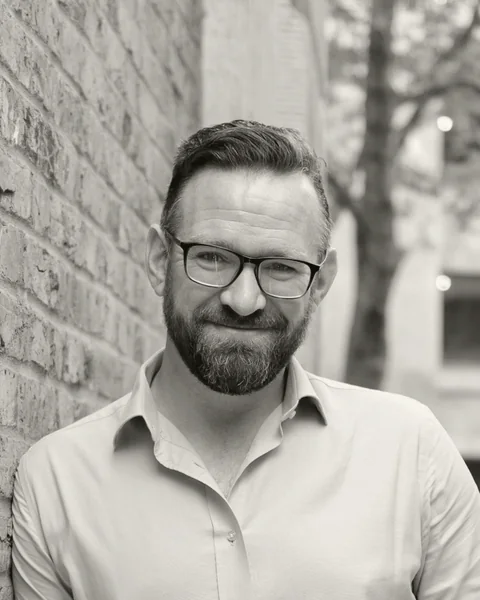
I spent years coaching rugby, watching players decide under pressure with incomplete information, and get it right or wrong for reasons nobody could quite name. That turned out to be the same problem everywhere: in companies, in emergencies, and in ordinary life. Almost nobody measures it.
It is also the problem underneath AI adoption. Policy is the easy half. The hard half is thousands of people deciding, under uncertainty, what they are allowed to do and whether to trust it. That is the work I do inside transformation programmes.
Most of what I do is strategy, and strategy is easy to claim. I stay for the part where it has to work: the guardrails people use, the playbook a team actually reaches for, the thing that changes on Monday. I build things of my own too, which keeps me honest about the difference between a recommendation and a working thing.
Twenty years of this has been across 25+ organisations, from growth businesses to a 17,000-person network. Organisations bring me in when the strategy is agreed and the change is not landing, sometimes to lead the work, sometimes to join a team already running it. I write decisions down as they happen, so what I leave behind can be run without me.
06 · CONTACT
Book a 20-minute call, or email me and tell me what is stuck.